
Pay Transparency: Must We? Can We? Should We?
Most of us get a little weird about pay. It’s a topic that triggers reactions not unlike discussing certain bodily malfunctions — awkward, personal, best avoided at dinner parties, but something we should address with professionals in the field.
On the psychology front, pay is bound up with self-worth. Asking someone what they earn is the modern eqatuivalent of “how many head of cattle do you own?” — a question still likely to set you off on a rocky foot with a rancher. Pay talk introduces a money-based pecking order into relationships and raises uncomfortable questions about how we value ourselves relative to others. We know intellectually that a person’s worth isn’t their W-2, but our culture makes that easy to forget.
On the privacy front, both employees and employers have skin in the game. Employees guard their pay for psychological reasons but also for negotiating leverage — if a prospective employer doesn’t know what you currently make, they can’t use it to justify a low offer. Employers cite competitive concerns: if rivals know your pay ranges and rates, they can poach your talent or reverse-engineer your margins.
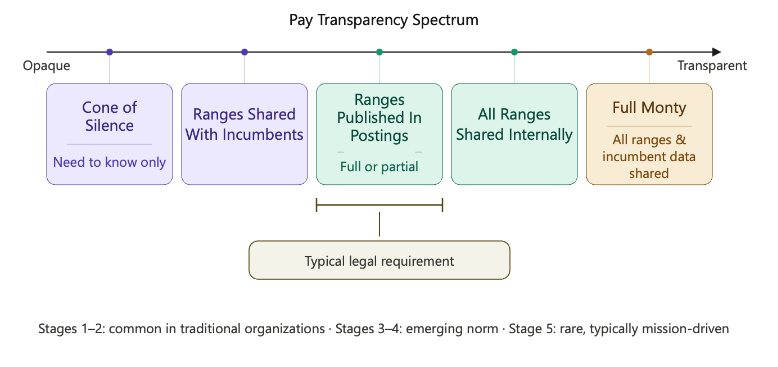
Pay transparency is a hot topic, but not a new one. Every organization has a position on it — explicit or implied. Like most things, it’s a spectrum. At one end, some organizations go Full Monty, publishing pay for everyone from the CEO to the summer intern. At the other, some push everything under a Cone of Silence, where only HR, Payroll, and the most senior leaders see anything compensation-related.
One more thing worth noting in our AI-focused times: pay remains a deeply human topic. AIs don’t draw salaries, aren’t protected by employment law, and won’t sit across from an employee to navigate a difficult conversation with empathy. That still falls to us.
Must’s
“It’s the law!” – Judge Dredd, The Law of Judge Dredd #21 (1989)
As of early 2026, 16 states and Washington D.C. have enacted pay transparency laws requiring employers to disclose salary ranges in job postings or upon request. These laws are primarily designed to close persistent wage gaps and they are spreading fast. The share of U.S. job postings that include a salary range jumped from 12% in 2019 to nearly 40% by 2024, driven largely by legislation. If your organization operates in multiple states, a patchwork of requirements likely already applies to you. For those of us in Alaska and Texas, neither state currently has a pay transparency law on the books, although Alaska has seen legislation introduced.
Can’s
“Just because you can doesn’t mean you should…” – (Every parent, circa Adam & Eve)
- We’ll get to the more consequential “should” shortly. On the “can,” U.S. employers are generally free to share compensation information internally or externally — with a few important guardrails:
- Privacy laws. Some states have enacted privacy protections that may apply to employee compensation data. International employers must also navigate the EU’s GDPR (sweeping data privacy regulations) and similar frameworks.
- Contractual obligations. Employment agreements often include confidentiality clauses restricting disclosure of individual pay. Sharing that data — even internally — could trigger breach of contract claims.
- Defamation and discrimination liability. Disclosing pay data without adequate context can backfire. If disparities surface that look discriminatory — even if they aren’t — you may be handing someone a lawsuit. That’s not a small risk: the EEOC secured nearly $700 million for discrimination victims in FY 2024, its highest recovery in recent history, and received 88,531 new charges — a 9% year-over-year increase.
What can’t employers do?
- Restrict employees from discussing their own pay. The National Labor Relations Act (NLRA) gives most private-sector employees a federally protected right to discuss their wages with coworkers. Organizations can restrict managers from disclosing others’ pay, but they cannot stop employees talking about their own.
- Ask about current or past salary in the application process. The trend has moved strongly against this once-common practice. More than 20 states and localities now restrict or ban salary history inquiries. Given the compliance complexity and the questionable value of the data, most legal counsel advises employers to drop the question entirely.
Should’s
“If you have nothing to hide, you have nothing to fear…” – (Logical fallacy used to justify increased government/corporate surveillance, circa 17th century)
This logically and ethically flawed rhetoric is often the unspoken subtext on the “for” side of pay transparency debates. However, an organization’s wariness about transparency is not, by itself, evidence of wrongdoing. But it is worth asking: what exactly are you afraid of?
The honest answer, for many organizations, is that their compensation history is a tangle of ad hoc decisions, market reactions, and inherited inequities that don’t hold up well to scrutiny. That’s not necessarily malicious — it’s the natural result of decades of individual negotiating, urgent critical hires, retention scrambles, and departmental budgeting. But it does mean that full transparency before you’ve done the remediation work can cause more harm than good.
Here’s a more useful framing: the goal isn’t transparency for its own sake. The goal is a compensation system you can explain. One where, if any employee asked why they earn what they earn, you can give a straight answer that holds up in a 1-1 and in court.
Here’s what we know about the impact of pay transparency from research and practitioner experience:
- Greater pay transparency works best in organizations that have already done the hard work of building a principled, documented compensation system — with the communications and manager training to support it.
- Sharing pay ranges internally measurably reduces pay inequity over time and improves employee trust. According to Mercer’s 2025 Global Pay Transparency Report, employees who perceive their pay as fair are 85% more engaged and 60% more committed to their organization. Start by sharing position pay ranges with the incumbents, then expand from there.
- Publishing ranges in job postings (legally required in many states, with more coming) levels the playing field for candidates and reduces the salary history anchoring problem. It also expands your talent pool: LinkedIn’s 2024 Workplace Report found that 61% of job seekers are more likely to apply to roles that list a salary range.
- Mid-spectrum approaches — sharing ranges and aggregate peer data without publishing individual salaries — capture most of the equity and trust benefits with significantly less organizational disruption.
The Bottom Line
Pay transparency is not the objective. It’s a variable in your organization’s risk management, culture, and employee engagement. Before tackling transparency, get the foundation right:
- Establish and maintain documented compensation strategies, policies, and values aligned with your mission and business objectives.
- Build compensation structures (pay grades and ranges) and clear processes for setting and adjusting pay throughout employment.
- Communicate and train employees and managers on your compensation strategy, structures, and processes.
- Focus on explainable pay rather than disclosed pay. An organization that can clearly articulate why every person earns what they earn — and demonstrates that the system is fair — is in a far stronger position than one that dumps data without context.
Do these things, and the transparency question will have answered itself.

About the author
Thomas Showalter is a Senior Consultant at PeopleAK and a Certified Compensation Professional (CCP) and SHRM Senior Certified Professional (SHRM-SCP). He helps Alaska employers build compensation structures, total rewards programs, and people strategies that hold up under scrutiny — including the kind of scrutiny pay transparency invites.
If your compensation system isn’t where you want it to be before the transparency conversation gets harder, talk to Thomas about a Compensation and Benefits Analysis.